
The GST Council on Wednesday approved two slabs of 5 per cent and 18 per cent effective from September 22, the first day of Navaratri.

Additionally, road cess on petrol was raised by Re 1 per litre each on petrol and diesel to Rs 10.
'Indian refiners can operate without Russian crude from a technical standpoint, but the shift would involve major economic and strategic trade-offs'


With Brent crude oil prices dipping below $100 per barrel, petrol prices may be cut by Re 1 a litre and there is also a likelihood of first reduction in diesel rates in seven years.

'Growth will definitely continue to come most from the sub-four-metre SUV segment, primarily because that is where the heart of economy and affordability is. Naturally, that will keep pushing the share of that segment (in overall PV sales) higher.'

Petrol price was on Wednesday hiked by a steep Rs 3.38 per litre and diesel by Rs 2.67 a litre, reversing a two-month declining trend.

Cement manufacturers have hiked prices after a challenging Q1FY25, and Q2FY25 (so far) when general elections and seasonal factors cut down on construction activity. The August prices are currently around 3-6 per cent above July 2024 but may not be sustainable in the face of weak demand. H2FY25 may see realisation growth which, if it happens, would drive average operating profit/tonne improvements in H2FY25 over a muted H1FY25.

Passenger vehicle dispatches from companies to dealers declined 9 per cent year-on-year to 321,840 units in August.

Normal or unbranded diesel currently attracts basic excise duty of Rs 1.46 a litre and an additional excise duty of Rs 2 per litre.

General Motors India Vice President P Balendran termed the decision as a positive move for the overall economy.

Electric vehicle (EV) manufacturers breathed a sigh of relief after the GST Council on Wednesday night retained the concessional 5 per cent rate on EVs, though they now face competition from small petrol and diesel cars, which will attract a lower 18 per cent levy.

In 2010, the govt had taken an "in-principle" decision to deregulate diesel prices, but could not implement it due to political pressure.
However, it may still not change its stance on the policy rate as inflationary pressures are coming from high commodity prices.
Petrol price was on Tuesday hiked by Rs 2.58 a litre and diesel by Rs 2.26 per litre, the second increase in rates this month.

Government-controlled oil-marketing companies (OMCs) have held back petrol and diesel price revisions for a week and are expected to continue doing so, ostensibly owing to political reasons. It appears that the Centre has informally conveyed to the three major OMCs to not revise fuel prices for the time being, two people in the government said. This informal directive follows the talks between the Centre and states on cutting taxes and bringing the auto fuels under the good service tax regime not fetching the desired results, so far.

For UK automakers, market access to India will be limited by quantity caps and phased tariff cuts, especially on petrol, diesel and electric vehicles.

The winner of the 2001 Nobel Prize for Economics says recovery could be difficult if the crisis in Egypt spreads to the entire region.

Jet fuel (ATF) price was on Monday hiked by a steep 56.5 per cent and that of non-subsidised cooking gas LPG by Rs 11.5 per cylinder on the back of firming up of international oil rates, but petrol and diesel prices continued to remain on freeze for a record 78th day. Aviation turbine fuel (ATF) price was hiked by Rs 12,126.75 per kilolitre (kl), or 56.5 per cent, to Rs 33,575.37 per kl in the national capital, according to a price notification by State-owned oil marketing companies.
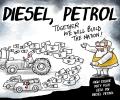
Petrol and diesel price soared to an all-time high across the country on Friday after rates were hiked again by 25 paise and 30 paise a litre, respectively. The price of petrol in Delhi rose it its highest ever level of Rs 101.89 a litre and to Rs 107.95 in Mumbai, according to a price notification of state-owned fuel retailers. Diesel rates too touched a record high of Rs 90.17 in Delhi and Rs 97.84 in Mumbai.

Diesel price needs to be revised upward, or subjected to higher taxes, as misuse of subsidized diesel was adding to pollution and public health costs, the government's pre-budget economic report card said on Thursday.

Finance Minister Arun Jaitley said the excise duty cut would have an impact of Rs 10,500 crore on central government's tax revenues.

The calculations done on June 25 were mostly based on the average international price in the first fortnight of June.
After today's reduction, petrol price has been cut by Rs 12.27 per litre cumulatively since August.

CNG price in the national capital on Friday was hiked by 80 paise per kg, while piped cooking gas rates were increased by a steep Rs 5 per cubic metre on the back of the government raising input natural gas prices to record levels. CNG price in the National Capital Territory (NCT) of Delhi has been increased to Rs 60.81 per kg from Rs 60.01, according to information posted on the website of Indraprastha Gas Ltd (IGL) -- the firm which retails CNG and piped cooking gas in the national capital. This is the sixth increase in CNG prices in the last month.
Petrol engines development has progressed well over the years and many of the current cars in India give a good mileage though they have to yet catch up with the fuel efficiency of diesel cars. Here we look most fuel-efficient petrol cars.
International oil prices have hit a six-month low, helping Indian fuel retailers breakeven on petrol but they continue to lose money on diesel - the most used fuel in the country, officials said. The world's best-known crude benchmark, Brent was trading at $94.91 per barrel on Thursday after concerns of a global recession led to it slipping to a six-month low of $91.51 on the previous day. The current rates are a relief to India, which is 85 per cent dependent on imports for meeting its oil needs.
India's annual oil import bill could rise by $9-11 billion if the country is compelled to move away from Russian crude in response to US threats of additional tariffs or penalties on Indian exports, analysts said. India, the world's third-largest oil consumer and importer, has reaped significant benefits by swiftly substituting market-priced oil with discounted Russian crude following Western sanctions on Moscow after its invasion of Ukraine in February 2022.

With fuel being the main input cost for the transport sector, rise in cost of operations is a given. The sector is unsure on the extent of being able to pass this on through rentals or to absorb it with higher volumes.

Reliance Industries Ltd, India's largest buyer of Russian oil and most impacted by the latest US sanctions, on Friday said it will comply with all applicable restrictions and will adjust its refinery operations to meet compliance requirements.

India's top fuel retailers IOC, BPCL and HPCL together lost around $2.25 billion (Rs 19,000 crore) in revenue for keeping petrol and diesel prices on hold during elections in five states, including Uttar Pradesh, Moody's Investors Services said on Thursday. State fuel retailers did not revise petrol and diesel rates for a record 137 days despite prices of crude oil (raw material for producing fuel) rising to $120 per barrel compared to around $82 in early November when the hiatus began. "Based on current market prices, the oil marketing companies are currently incurring a revenue loss of around $25 (over Rs 1,900) per barrel and $24 per barrel on sale of petrol and diesel, respectively," Moody's said in a report.

Indian rupee slipping below the record 88 level against the US dollar will enhance price competitiveness of Indian products in global markets and help exporters diversify beyond the US market, say exporters. However, import-dependent sectors such as gems and jewellery, petroleum and electronics may see lower benefits due to a rise in input costs, they stated.

'In the January-August period, the share of hatchback in the overall PV industry sales was about 22.4 per cent. In the September-October period, the share of hatchbacks has come down to 20.4 per cent. In just October, their share was just 20 per cent. This is simple wholesale data from industry body SIAM.'
While consumers feel that petrol pinches directly, diesel hurts indirectly, as it is an input in almost all the goods and services we use.
Expecting oil prices to remain under pressure, Fitch Ratings said deregulation of diesel prices in October will help in lowering the under-recoveries (which is nothing but international petroleum prices minus the subsidised retail rates).

If they act now, they can reshape the strategic map of Asia without firing a shot. If they wait, the next opportunity will come only after a serious Taiwan Strait incident -- by which time the price will be far higher, and the room for boldness far smaller -- the opportunity may well be lost by then. The question is no longer whether this can or should be done, points out Varun Arya.

The Congress took out marches and observed bandh at several places on Saturday to protest against rising fuel prices.
The over-recovery on diesel for such companies reached Rs 3.56 a litre for the first fortnight of October.

In the first reduction in rate in two months, jet fuel or ATF price on Thursday was cut by 3 per cent in line with softening international crude oil prices. Aviation turbine fuel (ATF) price was reduced by Rs 1,887 per kilolitre, or 3 per cent, to Rs 58,374.16 per kl in the national capital, according to a price notification of state-owned fuel retailers. This is the first reduction in rates after four rounds of increase since February. Rates were increased by Rs 3,246.75 per kl on February 1, followed by a 3.6 per cent hike on February 16, and a steep 6.5 per cent raise on March 1. On March 16, prices were again raised by Rs 860.25 per kl. On Thursday, a Rs 10 per cylinder reduction in price of domestic cooking gas LPG also came into effect.

The government on Thursday allowed state-run oil majors to fix diesel prices on their own in order to reduce an expanding subsidy bill and budget deficit. Oil companies announced a dual price mechanism while hiking the rates.
